
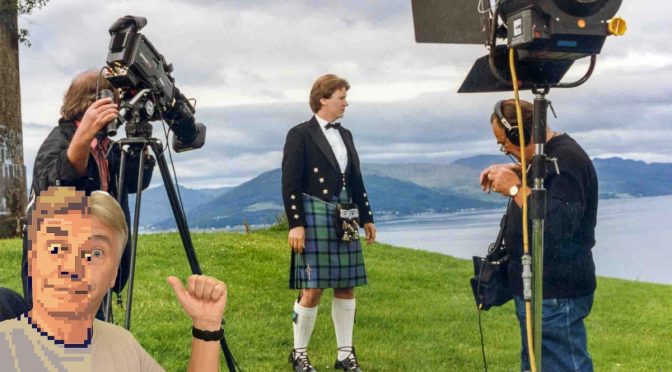
Every so often, Scotland comes up in conversation. Because of a referendum. Because of the whisky. Because of kilts. Or because you’re preparing for a Digisaurier journey through time. The latter was recently the case for me. It reminded me that I’d been there once. It was a filming trip for Neues… die Computershow (‘Neues… the Computer Show’). To a place that doesn’t actually exist as a geographical location, but whose origins go back as far as 1943: Silicon Glen. The area around Greenock, west of Glasgow. And when we were there in 1993, it was above all one thing: a place for dreams and ideas. Those of the people who saw new opportunities there. And our own. It was the second year of Neues…, and we had plenty of ideas and visions of what a computer programme on German television should be and how it should be done.
Not all of those ideas have survived to this day.
To our friends in Scotland, who gave us such a warm welcome back in 1993. For those of you who would like to read our story today, we’ve put together this English version.
When researching our Digisaurier time travel events, I always enjoy going through our old photographs. And that brings me back to August 1993. We were in ‘Silicon Glen’. A visit to a virtual world, so to speak. I’d already written an article about it for Digisaurier in 2014. I’ve now revisited and updated it.
It’s a place with a history, even though it doesn’t really exist as a place. Silicon Glen. And we were a television programme that wanted to tell stories. Something that didn’t really exist in the world of computing either. But more on that in a moment. First, a few words about our filming location…
Silicon Glen 1993 – A Region on the Rise

Silicon Glen, as BBC reporter James Arnold noted in 2003, isn’t an area. It’s more of an idea. In his article, he writes about the death and rebirth of Silicon Glen. A stretch of land between Glasgow and Edinburgh. Born – as a virtual place – as early as 1943, according to Wikipedia. Fifty years before we went there:
Silicon Glen had its origins in the electronics business with Ferranti establishing a plant in Edinburgh in 1943. NCR Corporation, Honeywell and Burroughs Corporation followed in the late 1940s with IBM being a very significant import when it opened a manufacturing facility in Greenock in 1953. Indeed this was typical of much of the early days of Silicon Glen, which were dominated by electronics manufacturing for foreign companies much more than research and development or the establishment of home grown companies.

When we were there, there was a tremendous sense of optimism. IBM, for instance, was manufacturing hardware in Greenock at the time. This was the era when the company had already switched from Charlie Chaplin to the Pink Panther in its advertising. ThinkPads, IBM’s notebook brand back then, were manufactured there. People were enthusing about a Scottish Silicon Valley, about innovation and new opportunities. And for a while, it seems to have worked. In 1997, the German news magazine Der Spiegel also wrote about Silicon Glen, albeit critically, as part of a cover story entitled ‘Everyone’s creating jobs – except us’. By ‘us’, of course, they meant Germany.
At present, there is virtually no stopping the investors. In Scotland, the stretch of land between Glasgow and Edinburgh has long been known as ‘Silicon Glen’. All the big names in the computer and chip industries are represented here: IBM and Motorola, NEC, Samsung and Compaq. One in every three personal computers manufactured in Europe now comes from the region.
— DER SPIEGEL 17/1997 – ‘The Unemployed Are Benefiting’
So that was the era when names were still around that have long since passed into history. Speaking of names, I’m often asked why we gave our computer programme on 3sat such an ordinary name as Neues…. The reason was simple…
‘Neues…’ – The Name Was Meant to Say It All

Perhaps one day I’ll do a series of photographs and stories about some of the rather odd things we got up to on our programmes. But rather than leave that as just a headline, here are a few examples.
In our very first programme, we threw laptops off a table and invited the bosses of the companies that made them to switch the things back on themselves, to see whether they’d survived the fall. ‘A portable computer might get dropped from time to time,’ was our argument. The funny thing was that the company bosses knew nothing about the test. They’d only been told they were coming along for a panel discussion.

On a ferry, we tested a ‘love letter generator’ with young couples. A piece of software designed to help win a lady’s heart – a sort of electronic Cyrano de Bergerac – even if you couldn’t always find the right words yourself. Could the ladies tell the difference between the love letters the gentlemen had written themselves and those generated by the computer?
We asked Konrad Kujau, who had become famous for forging the Hitler diaries, for his expert opinion. At the time, a legal battle was raging between Apple and Microsoft, so we wanted him, as an expert, to tell us who had pinched what from whom when it came to the user interface. Incidentally, they’d all helped themselves to ideas from Xerox, although Apple was the first to bring them to users. With the Lisa. But that’s another story.
Neues… in 1993 – We Didn’t Want to Be a Computer Magazine on Television

I think we always held our colleagues in the print media in higher regard than they held us. And looking back, I can quite understand why. To a journalist who was expected to write several pages of a review (and had the space to do so), we were superficial and out to create a spectacle. We didn’t test things with the same thoroughness, attention to detail or precision. We simply dropped laptops off tables. In short, in the eyes of our colleagues, we must have seemed like a bunch of travelling showmen who really shouldn’t be let loose on serious computer users.
The funny thing was, though, that there were more and more computer users who clearly preferred a slightly more light-hearted approach. At Neues…, we’d dedicated ourselves to telling stories. Not to tinkering with circuit boards, nor to publishing listings that people could type in to get programs for their own computers. All of those were perfectly legitimate and important elements of the computer era. Particularly before the internet. But what we wanted to offer was, quite literally, something new – Neues….
We valued our colleagues at the magazines precisely because of their thorough reviews and information. But above all because, as we read their articles, we’d get ideas about which details we could bring to television and how we might do it. Making it entertaining and living up to the title of our programme, Neues… die Computershow.
A show, after all…
Painting in Scotland – Our Take on a CorelDRAW Review

A good example was our filming trip to Scotland. The region we were in, Silicon Glen, offered wonderful landscapes and magnificent lochs. A great place for painters. The painting and drawing software CorelDRAW (which, incidentally, is still around…) had just come out with some new features. One of them was the ability to depict grass, water, trees and so on in a particularly lifelike way.
That’s precisely what we seized upon. Not the countless other new features. Just that one.
That was part of the criticism we later received from colleagues. ‘But Corel is so much more than that…’
True. And you could read all about it in reviews everywhere. For us, it was that one particular feature. It worked for television. And Corel enthusiastically went along with it. The company nominated a computer artist who came to Scotland and completed the task as well as anyone could with that sort of software at the time.
More realistic than before. But still a long way from realistic.
I think we made a lot of people curious about CorelDRAW. And they then went off and read magazines. With detailed reviews. A division of labour between the media, really.
Why Do They Put This Windbag in Front of a Camera?

We weren’t a magazine programme and never wanted to be one. We were a show. And then, for me personally, there was ZDF as well. The morning magazine programme, the lunchtime magazine programme, heute-journal. Even commercial broadcasters invited me on as an expert.
That didn’t exactly make me any more popular with some of my colleagues in the print media. Particularly as they repeatedly pointed out – and, as I’ve said, in a way quite rightly – that our approach was far too superficial. Too keen on simple answers. Too reliant on overly simplistic examples.
They were right. But in three minutes and thirty seconds, that was the aim. On ZDF’s morning or lunchtime magazine programmes, no appearance could last any longer than that. Four minutes if you were lucky. And on our own programme it was much the same, because it was a magazine-format show.
It wasn’t until Neues… der Anwenderkurs (‘the User’s Course’) that we had more time to explain things. But even that could never compete with an article or a book in terms of the written word. Nor was it supposed to. We were always short of time. We were always having to cut things down. When it came to computers, we were the ‘rapid response team’, so to speak.
And curiously enough, that was precisely why the broadcasters gave us, and me personally, such a big stage in the form of programmes with a wide audience. They could be confident that things wouldn’t get too complicated.
And I suspect more than a few colleagues thought to themselves: ‘Why do they put this windbag in front of a camera when he knows far less than I do, for instance?’
Sometimes, quite frankly, I wondered the same thing myself.
All of this brought us criticism, sometimes ridicule and, on occasion, some rather personal mockery. But it also brought rising viewing figures. Over the years, right up until around 2000, Neues… worked its way up to an audience of as many as half a million viewers. That was considerably above the average for 3sat. And thanks to its success, one programme grew into a whole family of programmes: Neues… ‘the User’s Course’, ‘the Magazine’, ‘Computers for Kids’, ‘from Computer Editorial Teams’.
The Road to the Internet – ChipTV & Co.
After 2000, I rather lost sight of Neues…. My own path took me away from the broadcaster and towards internet television, which didn’t really exist yet. (Yes, this was before YouTube. Long before…)
Technically, the best you could get was twice the speed of ISDN (2 × 64 kbit/s ;-) ), but I could see a future there. Together with colleagues such as Hans-Günther Beer, Rainer Grabowski and Thomas Pyczack, we went on to establish Chip-TV, probably the first regular computer programme on the internet at the time.
But that’s another story too.

I think that with Neues…, we did our bit towards the ‘digital agenda’, which didn’t exist back then. On the road into uncharted territory. It was precisely by taking these different routes that we became one small cog in the history of digitalisation in Germany. No more, but no less either.
I’m glad that courageous television colleagues such as Klaus Möller and Leo Boehner, as founding editors, were willing to go down those routes. And that the Neues… team went along with it all over the years. That a brilliant director like Peter Schönhofer (who later went on to direct some really major television productions, from entertainment shows to theatre and opera) was willing to take on a subject that wasn’t exactly the most visual to begin with. And that colleagues such as Hannes Rügheimer and Michael Kloss put their trust in me and contributed their expertise to programmes such as the Anwenderkurs.
And, of course, mention must be made of the companies that agreed to take part in our ‘tests’. Something that couldn’t be taken for granted.
Because, much like Silicon Glen itself, we had our successes and setbacks with our concept. Critics and fans.
What I find interesting is that Neues… was always successful with viewers when we told stories. Even later on, when Yve Fehring presented Neues… and the programme turned its attention to the social and political aspects of IT and related subjects. It quite rightly went on to receive the Grimme Award. Perhaps also because it had stuck with it and remained true to something that had been one of its distinctive features from 1992 to 2011: telling stories, even when the subject was technology.
In 2011, Neues… was taken off the air. Sad, on the one hand. The right decision, on the other. Given the developments on the internet and the countless videos covering our subjects, the days of the traditional computer programme were over.
And so Neues… went the way of motoring programmes on television. Everyone has a car, but for most people, the magazine programmes about them aren’t all that important. And whilst motoring can still attract a few million viewers, computing no longer brings in the television ratings.
But it does get clicks on the internet.
Justice for the Expertise of Our Print Colleagues…

And what about our colleagues in print? Their world hasn’t got any easier either. But there is some justice.
Thanks to YouTube and the like – which are now there to inform people who want to know or understand something – our colleagues simply make their own programmes. And every so often, someone like Jörg Schieb appears on television as an expert. He, too, came from the world of books and articles and has now been working with moving images for a very long time.
I imagine that over the years, the two sides – television and print – have moved closer together. But I’m sure those colleagues, too, now have to listen to someone back in the editorial office afterwards saying:
‘Well… it was good. But perhaps you should also have mentioned that…’
Fair enough. In a way.
But working with moving images, and doing it practically live, is rather different from writing an article several pages long, with the luxury of time to do it. And for anyone who has to go on television or radio, the same rule applies:
Three minutes thirty is three minutes thirty… ;-)
And now – if anyone has actually read this far – I’d be delighted to see your likes, comments and memories…
Note: This article was originally published in 2014 and has now been revised.
Original article: Schottland: Silicon Glen – ein Traum von Zukunft
Author: Christian Spanik, Digisaurier
